
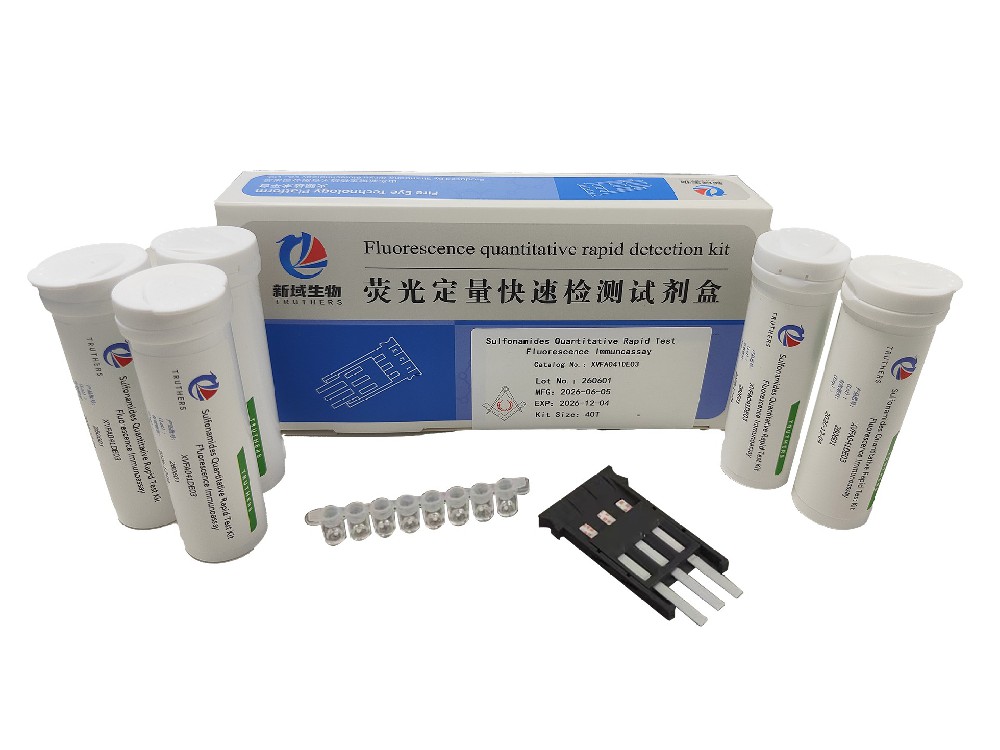
Chloramphenicol Quantitative Rapid Test Kit
Fluorescence Immunoassay
This competitive quantum dot fluorescence immunochromatographic assay quantitatively screens chloramphenicol residues in livestock and poultry tissues across a detection range of 0.05–0.3 µg/kg. After sample addition, the XY-1200 automatically incubates and reads the test card, delivering results in 12 minutes.
Performance data
LOD
0.05 µg/kg
Detection Range
0.05–0.3 µg/kg
Recovery
80-120%
Precision
CV≤10%
Specifications
| Catalog No. | XVFA031RE03 |
|---|---|
| Product Name | Chloramphenicol Quantitative Rapid Test Kit |
| Target Analyte | Chloramphenicol residues |
| Detection Technology | Competitive quantum dot fluorescence immunochromatography |
| Result Type | Quantitative, automatically read by the XY-1200 |
| Applicable Matrix | Livestock and poultry tissues |
| Sample Preparation | Direct Extraction (followed by centrifugation and dilution) |
| Sample Volume | 150 µL |
| Time to Result | 12 min from sample addition to result (automatic incubation and reading) |
| Pack Size | 40 tests |
| Storage & Shelf Life | Store sealed, in dry conditions, protected from light. 6 months at 10–30°C or 12 months at 2–10°C. Do not freeze. |
| Compatible Analyzer | XY-1200 Integrated Incubation and Fluorescence Reader |
| Relative Cross-Reactivity | — |
Kit Components
1. Detection Kit Components (40 Tests)
| Component | Quantity |
|---|---|
| Microwells | 8 wells × 5 strips = 40 wells |
| Test Strips | 40 strips |
| USB Drive | 1 pc |
| Instruction Manual | 1 copy |
2. Sample Preparation Kit II Components (Available Separately)
| Component | Quantity |
|---|---|
| Salt Solution | 2 bottles × 50 mL |
| Sample Extraction Solution E | 4 bottles × 50 mL |
| Dilution Buffer 03 | 1 bottle × 25 mL |
| Instruction Manual | 1 copy |
Sample Preparation Kit II Procedure
Weigh 2.00 g ± 0.02 g of homogenized sample into a 10 mL centrifuge tube. Add 2 mL of Salt Solution and shake for 2 minutes. Add 4 mL of Sample Extraction Solution E and shake for 3–5 minutes. Centrifuge at 4,000 rpm for 5 minutes. Transfer 2 mL of the supernatant to a 10 mL centrifuge tube and dry at 60°C. Reconstitute with 400 µL of Dilution Buffer 03 and vortex for 30 seconds before analysis.
Compatible Assays Using the Same Sample Preparation
| Compatible Assay | Sample Supernatant | Dilution Buffer 03 | Applicable Matrix |
|---|---|---|---|
| Chloramphenicol | 2 mL | 400 µL | Livestock and poultry tissues |
| Metronidazole | 2 mL | 400 µL | Livestock and poultry tissues |
| Pentachlorophenol Sodium | 2 mL | 400 µL | Livestock and poultry tissues |
| Ofloxacin | 2 mL | 400 µL | Livestock and poultry tissues |
| Chlorpromazine | 2 mL | 400 µL | Livestock and poultry tissues |
Required Instruments and Materials (Not Provided)
XY‑1200 Integrated Incubation and Fluorescence Reader
Electronic balance
Sample homogenizer
Shaker
Vortex mixer
Centrifuge
10 mL centrifuge tubes
Dryer (for evaporation at 60°C)
20‑200 µL and 100‑1,000 µL pipettes with compatible tips
Sample Preparation Kit II for the validated livestock and poultry tissue protocol (available separately)
Note: For compatible instruments and consumables, please contact the manufacturer.
Why Our Solution Stands Out
Designed for rapid quantitative screening of veterinary drug residues in foods of animal origin, Xinyu Bio's fluorescence immunoassay solution combines matched test kits, standardized sample preparation and automated instrument reading for routine quality control across the farm-to-table supply chain.
Automated, High-Throughput Testing
After sample addition, the XY-1200 automatically completes incubation and fluorescence reading. Up to 12 samples can be processed per run, with results available in 12 minutes, reducing hands-on time for routine batch screening.
Reliable Quantitative Performance
Quantum dot fluorescence immunochromatography combines sensitive detection with instrument-based signal analysis for objective quantitative results. Validated matrices typically achieve 80-120% recovery, supporting consistent routine screening.
Streamlined Workflows, Traceable Data
Matched sample preparation kits standardize extraction, dilution and cleanup across the product portfolio. Within compatible assay groups, one sample extract can support multiple residue tests, while integrated data management enables result storage, review and traceability.